





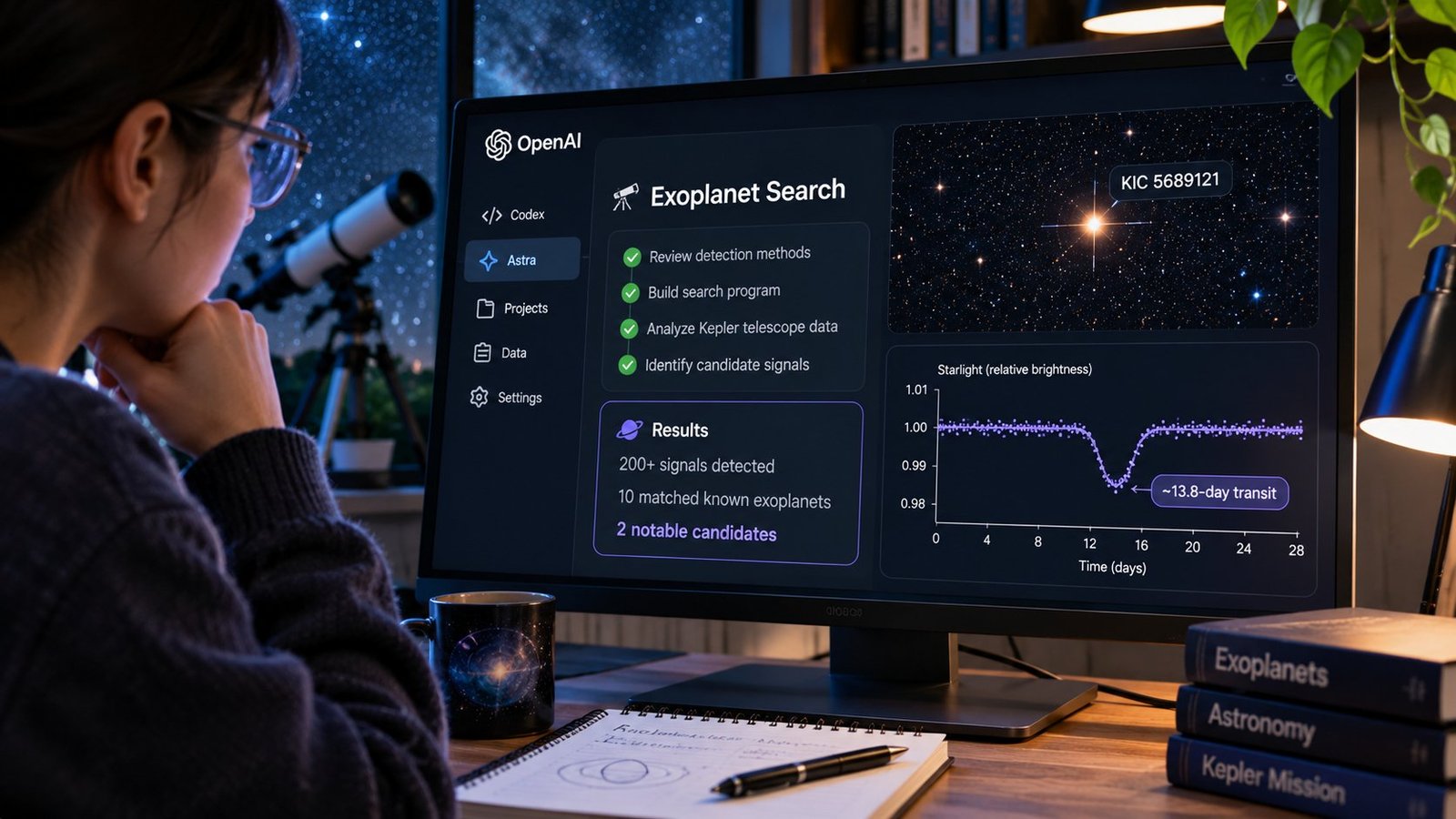
A star in the constellation Lyra appears to dim every 13.8 days in old NASA telescope data. Years after those observations were collected, an amateur astronomer using OpenAI’s Codex helped bring the faint signal back into view.
OpenAI reported Nov. 24 that two astronomy enthusiasts used its Codex and Astra tools to search public telescope archives, identifying two particularly promising signals and another 49 preliminary exoplanet candidates. Their work suggests AI assistants could help people without professional astronomy training investigate data that scientists have been studying for years.
None of the findings is a confirmed planet. But an astronomer at the SETI Institute independently identified two of the signals, giving researchers a starting point for further investigation.
How Codex and Astra searched NASA’s telescope archives
According to OpenAI’s announcement, the two participants took different approaches to the search.
Kevin Bond: Finding signals in Kepler data
Kevin Bond, an OpenAI engineer and amateur astrophotographer, used Codex to develop software for detecting possible planetary transits.
A transit occurs when a planet crosses in front of its star, temporarily blocking a small amount of light. If that dimming repeats at regular intervals, astronomers may have found evidence of an orbiting planet.
Bond used Codex to compare published detection methods, combine them into a search program, and improve the code through testing.
He then searched observations of approximately 100,000 stars collected by NASA’s Kepler Space Telescope.
The program flagged more than 200 signals, including 10 belonging to already-confirmed planets.
Two additional signals stood out:
- KIC 5689121: A relatively cool star in the constellation Lyra that appears to dim every 13.8 days. If a planet causes the signal, it could be approximately 2.4 times Earth’s diameter.
- KIC 6691030: A faint star with a recurring 4.8-day dimming pattern consistent with a possible planet smaller than Neptune.
An astronomer at the SETI Institute independently identified both signals using a separate search method.
That provides additional confidence that the patterns exist in the data, although their planetary origins remain unconfirmed.
Recovering 10 known planets also demonstrated that Bond’s software could recognize genuine signals. However, OpenAI didn’t publish a false-positive rate for the other detections.
Ethan Byrd: Searching millions of stars with Astra
Ethan Byrd, founder of the email infrastructure startup Primitive, used Astra to analyze observations covering approximately 19 million stars.
His approach involved two searches. One scanned broadly for possible exoplanets, while the other concentrated on stars’ habitable zones.
A habitable zone is the region around a star where a planet with suitable atmospheric conditions might support liquid water.
Byrd asked Astra to examine published detection techniques, build the necessary software, and run initial checks on promising signals.
The first pass produced 49 exoplanet candidates.
One has been submitted to researchers working with NASA’s Transiting Exoplanet Survey Satellite (TESS) mission for further analysis. Two others are awaiting submission, and the search is continuing.
Unlike a specialized astronomy model trained exclusively to recognize planetary transits, Astra helped organize and carry out a broader research workflow.
That reflects a growing use of AI coding assistants for tasks beyond traditional software development.
Why possible exoplanets still need verification
A recurring dip in starlight is an encouraging clue, but several phenomena can imitate a planetary transit.
Two stars orbiting each other can produce similar dimming patterns. Changes in a telescope’s instruments can also create misleading measurements.
Even a clean-looking signal may become less convincing when astronomers examine individual observations rather than averaging years of data together.
A 2026 study published in Monthly Notices of the Royal Astronomical Society examined how localized defects and statistical false alarms can mislead searches of Kepler observations.
The researchers identified several previously reported candidates whose signals became less convincing after additional checks.
To investigate a potential planet, astronomers may need to:
- Confirm the pattern: Check whether the star dims repeatedly at the predicted intervals.
- Inspect individual observations: Look for instrument errors, sudden changes, or suspicious data gaps.
- Rule out other explanations: Determine whether another star or an instrumental effect could produce the same signal.
- Collect additional evidence: Use new observations or other techniques, such as measuring the gravitational influence of an orbiting planet on its star.
The process can take months or years, particularly when the possible planet is difficult to observe.
The two Kepler signals identified by Bond have passed an independent detection check, but that isn’t equivalent to confirming an exoplanet.
Byrd’s 49 candidates are at an earlier stage, with one awaiting additional examination by TESS researchers.
The distinction also applies to other scientific uses of AI. OpenAI previously used nearly 2,000 AI agents to analyze brain-cell data, generating possible connections to neurological disorders that still require laboratory validation.
Faster analysis can produce more research leads, but the number of candidates alone doesn’t establish their accuracy.
How amateur astronomers can participate
One of the more interesting aspects of OpenAI’s announcement is that neither participant needed to launch a telescope or collect a new set of observations.
Both worked with data already available to researchers and the public.
NASA’s Exoplanet Watch program offers a way for interested readers to take part in similar research, even without owning a telescope.
Participants can:
- Request existing telescope data. NASA’s Exoplanet Watch program lets participants analyze observations without owning a telescope.
- Analyze the measurements. The free EXOTIC software helps participants turn observations into graphs showing changes in a star’s brightness.
- Share their findings. Results can be submitted to the American Association of Variable Star Observers for use in ongoing research.
People with suitable telescopes can also collect observations themselves and contribute to coordinated campaigns.
AI coding tools may make it easier for technically inclined participants to build custom search programs. But researchers still need to check whether those programs recover known planets, produce false alarms, or mistake telescope artifacts for real signals.
Other research efforts, including AI models studying genetic variants, face a similar challenge: Computational predictions need independent evidence before researchers can rely on them.
OpenAI’s exoplanet searches haven’t established the existence of any new planets. Their immediate achievement is giving amateur astronomers another way to sift through enormous public datasets and identify observations that deserve a closer look.
If further analysis confirms even one of these candidates, the discovery will begin with data collected years ago and a search that AI helped make possible.
Also read: OpenAI’s GPT-6.2 helped design proteins that successfully bound to biological targets in laboratory experiments, with further testing needed to establish their potential applications.