






Pregnant, with two young children and no close relatives in Samarkand, she called a familiar number with trembling hands: the Rahmdillik (“Compassion”) crisis centre, where she had sheltered before. “Come right now,” came the reply.
Behind a heavy iron gate of an old mansion in central Samarkand lies a small courtyard, where a huge, spreading persimmon tree hangs laden with ripe fruit.
Women of all ages – some in traditional Uzbek dress and headscarves, others in robes or tracksuits – smile warmly at visitors. Each has her own story, but all have fled violence or been left without shelter or any means of support.
A small UN delegation led by Sabine Machl, the UN Resident Coordinator in Uzbekistan, is welcomed by the centre’s founder, Bibisora Oripova, who points out the latest improvements: a large new television, another renovated room and a sewing workshop.
Rahmdillik (“Compassion”) centre in Samarkand, Uzbekistan.
Burned and outcast
Dr. Oripova, a surgeon with many years of experience, opened Rahmdillik in 1996. The idea had come to her earlier, while she was working in the burns unit of a local hospital.
“Our unit had many women and children who had suffered burns, were disfigured and had become disabled. Often, their husbands refused to take them back. Where could they go?
“In the Soviet Union, treatment was free, so they stayed in hospital – practically living there. But eventually that was no longer possible,” she says. “I went to the hokim [local official] and asked for a dormitory or some other building where I could shelter women who had nowhere to live.”
As demand grew, the centre expanded, with support from the government and external donors, including UN agencies. Over the years, hundreds of women have passed through its doors.
Bibisora Oripova, Rahmdillik (“Compassion”) crisis centre’s founder and Sabine Machl, the UN Resident Coordinator in Uzbekistan.
More than a roof
“We are a traditional society. Some families still do not want women to study or work; they marry them off young. Women have children and do the housework. They are entirely dependent on their husbands’ families,” Dr. Oripova says.
The centre can house up to 50 women at a time. Today, it offers them more than a roof over their heads: legal and psychological support, vocational training and help finding a job, all tailored to each woman.
If she decides to go to the police, staff help her prepare a complaint and accompany her through the process.
“When a woman has to leave home in a hurry, documents are the last thing on her mind. The priority is to get to safety,” says Ms. Machl. “That is why these facilities are essential: they give women someone to turn to during the most difficult period.”
Together with the UN Population Fund (UNFPA) in Uzbekistan and other partners, centre staff also monitor whether the rights of women who have experienced violence are respected.
Most women choose not to go to the police, hoping to wait things out and keep their families together. “They often say they do not want their children to be left without a father,” Dr. Oripova explains.
If a woman decides to leave her husband, staff appeal to the authorities on her behalf for housing and an allowance to support her children.
A fruit-laden tree with orange fruit in an urban courtyard in Samarkand.
Babies are placed in nurseries, while older children go to school.
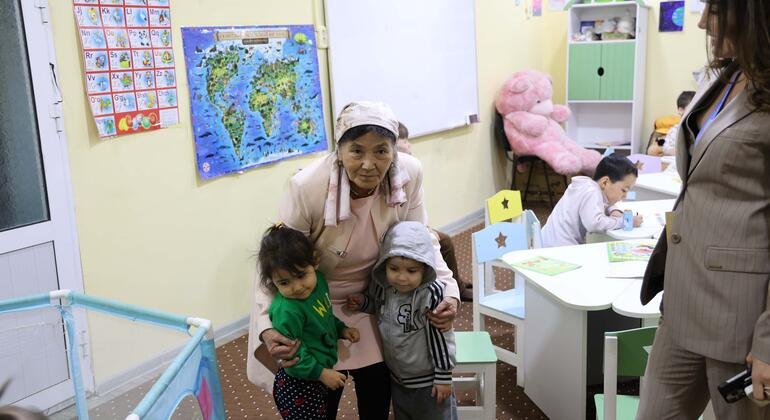
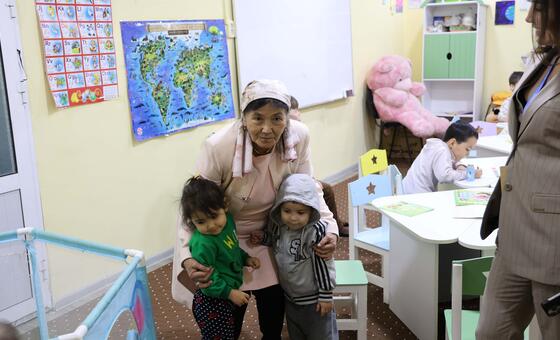
“Would you like to come and see our children’s room?” Dr. Oripova asks. The spacious, bright room is carpeted, and its walls are hung with educational materials. The furniture is new, and small children sit at tables making crafts under the watchful eye of a young woman.
Beyond the official figures
In 2023, the authorities in Uzbekistan reported to the UN that 40,055 cases of violence and harassment against women had been identified, and that 39,263 women had received protection orders.
These figures reflect reported and identified cases rather than the true scale of violence, which is likely far greater: many women do not seek help because of pressure, shame and financial dependence.
In Uzbekistan, as in many countries, violence against women most often takes place at home. The perpetrators are usually husbands, but violence also occurs between female relatives – between a mother-in-law and daughter-in-law, for example.
Psychological and physical violence, along with harassment, are the most commonly reported forms. A UN study found that around 40 per cent of women believe a husband may be justified in beating his wife in certain situations.
The children’s room in the Rahmdillik (“Compassion”) crisis centre in Samarkand, Uzbekistan.
“The government is doing a great deal through its specialized Inson centres, which now operate throughout Uzbekistan and help women, including through shelters,” Ms. Machl told UN News. “The priority should be to support women urgently, without blaming them or putting them through lengthy procedures that traumatize them again.”
At Inson centres, specialists use updated UNFPA guidance to assess risks and identify different forms of violence. It helps them recognise that complaints about arguments or restrictions may point to psychological control, financial restrictions, physical threats or sexual coercion.
If a woman is forbidden to see her friends, for example, a specialist will ask whether her access to money for phone calls and transport is also restricted, and whether the prohibitions come with threats. This helps reveal a broader pattern of control and identify the right protective measures.
Bibisora Oripova, Rahmdillik (“Compassion”) crisis center’s founder and Sabine Machl, the UN Resident Coordinator in Uzbekistan.
‘We are not homeless’
Irina has lived at the shelter with her three children for more than two years, and her youngest was born there. She has no plans to return to her husband, is waiting for an apartment from the state and is looking for a permanent job. Her older children attend a nearby school.
“You know, they once filmed us here and then showed us as homeless. But we are not homeless: today, we have this home, and each of us is trying to get back on her feet and find her own path. Many of us succeed,” Irina says.